

The Pacific Northwest has a reputation for serious hiking — glacier-covered volcanoes, rugged backcountry, and trails that demand skill and multi-day commitment. That reputation is earned. But it tells only half the story. Washington and Oregon are also home to some of the most accessible, rewarding, and genuinely stunning beginner trails in the entire country.
Stacey Slamka has hiked across both states, including time on the slopes of Mount Rainier and Mount Saint Helens. The region has a way of turning a first-time hiker into a lifelong one — if you start on the right trail. Here are the ones worth knowing about.
Naches Peak Loop — Mount Rainier, Washington
Distance: 3.2 miles | Elevation Gain: 600 feet | Difficulty: Easy
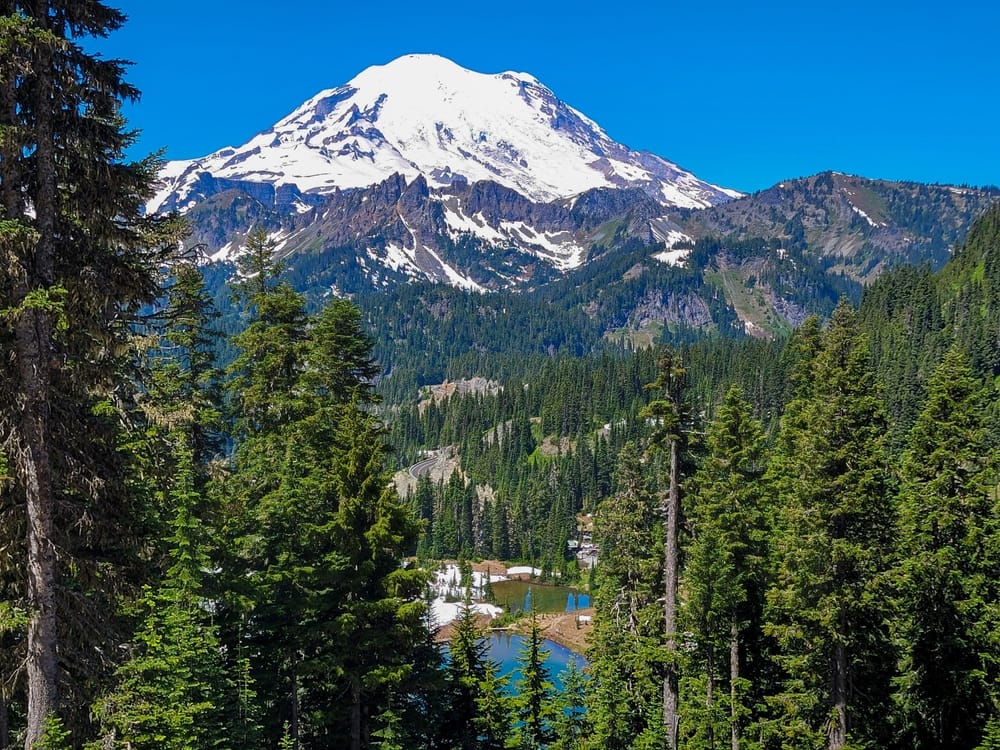
This is one of the most frequently recommended beginner hikes in the entire Pacific Northwest, and for good reason. The trail begins at Tipsoo Lake, where Mount Rainier’s snow-covered dome reflects off the still water before you’ve taken a single step. From there, the loop winds through meadows that explode with wildflowers in July and August, past grazing mountain goats and lounging marmots, with views of Mount Rainier dominating the skyline throughout. On a clear day, Mount St. Helens, Mount Adams, and Mount Hood are all visible on the horizon. The Sunrise Road access typically opens in early July and closes in early fall, so timing matters. A National Park Pass is required.
Skyline Trail — Mount Rainier, Washington
Distance: 5.5 miles | Elevation Gain: 1,400 feet | Difficulty: Moderate
For first-time hikers who want a step up in challenge without venturing into serious backcountry territory, the Skyline Trail is the go-to recommendation. The trail climbs to Panorama Point at just under 7,000 feet — the halfway point to Camp Muir — where the Nisqually Glacier sprawls below and Rainier towers overhead. The meadows on the ascent are vivid with wildflowers through summer, and the overall loop offers one of the best payoffs-per-mile ratios of any trail in the park. Go counter-clockwise for a more gradual ascent and to hit the wildflowers first.
Multnomah Falls Trail — Columbia River Gorge, Oregon
Distance: 2.4 miles roundtrip | Elevation Gain: 700 feet | Difficulty: Easy to Moderate
One of the most visited natural landmarks in Oregon, Multnomah Falls drops 620 feet in two tiers and is visible from the trailhead. For first-timers, the hike to the bridge at the base of the upper falls is short, spectacular, and memorable. Those wanting more can continue up a series of switchbacks to the top of the falls for views over the Columbia River Gorge. Timed entry tickets are required during peak season — check ahead before visiting.
Harry’s Ridge Trail — Mount Saint Helens, Washington
Distance: 8.0 miles roundtrip | Elevation Gain: 1,450 feet | Difficulty: Moderate
For hikers wanting to explore the volcanic landscape of Mount Saint Helens, Harry’s Ridge is the standout trail. The route follows the ridge above Spirit Lake, with the crater and lava dome of Saint Helens in full view throughout. The landscape here is unlike anything else in the Pacific Northwest — a stark, still-recovering terrain that tells the story of the 1980 eruption at every turn. It’s longer than the other trails on this list, but the grade is manageable and the views are extraordinary.
Eagle Creek Trail — Columbia River Gorge, Oregon
Distance: 4 to 12 miles roundtrip | Difficulty: Easy to Moderate
Eagle Creek is one of the most beloved trails in the Gorge — a lush, forested canyon path that follows a rushing creek past a series of waterfalls. The trail is flexible by design: shorter out-and-back options work well for beginners, while stronger hikers can extend the trip deeper into the canyon. Check current conditions before visiting, as sections of the trail have seen closures in recent years due to fire damage, with ongoing restoration efforts.
A Note on Timing and Conditions
Most Pacific Northwest trails at elevation are best accessed between late June and early October, when snow has cleared and trail conditions are stable. Weather in the region shifts quickly — even in summer — so layering is essential regardless of the forecast. Always check the relevant park or forest website for current conditions and any active closures before heading out.
For Stacey Slamka, the Pacific Northwest is where a love of hiking takes root. The trails here have a way of raising the bar for everything that comes after — and for first-timers, that’s exactly the point.
About Stacey Slamka
Stacey Slamka is an avid hiker and outdoor adventurer who has explored trails across the United States, from the volcanic landscapes of Mount Rainier and Mount Saint Helens in Washington to the forests of Oregon, Idaho, Utah, and Vermont. In 2026, she has her sights set on Montana, Wyoming, North Dakota, and South Dakota.
Leave a Reply